
Here’s something nobody talks about when selling outdoor furniture. Most of it won’t last three summers in a genuinely hot climate. Plastic buckles. Metal gets so hot that you can’t sit on it without burning skin. That “weather-resistant wicker” from the big box store? It starts unravelling the moment a real sandstorm rolls through. And yet the furniture industry keeps pushing these materials as if Dubai, Doha, Riyadh, Phoenix, and Perth don’t exist on the map.
The outdoor furniture market hit roughly USD 53 billion in 2024, per Fortune Business Insights, with projections north of USD 81 billion by 2032. Wood still dominates over 65% of that revenue. And within the wood category, teak sits at the absolute top. Not because of marketing. Because of five hundred years of field-tested proof that it works where nothing else does.
This piece breaks down exactly why teak outdoor furniture handles extreme heat and sandstorms better than every alternative. No fluff. Just material science, real-world performance data, and practical buying guidance for anyone furnishing outdoor spaces in punishing climates.
What Actually Happens to Furniture in 50°C Heat
People in temperate climates don’t think about this. But when ground temperatures push past 50°C, and that’s a regular Tuesday in parts of the Middle East or the Australian outback during summer, outdoor furniture enters a war zone.
Plastics crack. Not eventually. Fast. Polypropylene chairs develop hairline fractures along stress points within a single season. Two seasons, and the legs snap during a dinner party. Embarrassing at best. Dangerous at worst.
Aluminium? The material itself won’t melt, obviously. But good luck sitting on it at 2 pm in July without a towel barrier. Powder-coated aluminium still conducts and retains heat like a frying pan. And here’s the part people overlook entirely.
Desert sand particles travelling at 50 to 60 kilometres per hour act like low-grade sandblasting equipment. One storm and your powder-coated finish is scratched to bare metal. Two storms and you’ve got visible corrosion starting.
Engineered wood composites tell a similar story with a different ending. The binding resins break down under sustained UV exposure. Edges delaminate. Surfaces bubble. The colour goes patchy. What looked impressive in the showroom photograph now looks like it was pulled from a skip.
So what survives?
Related – Teak Furniture Malaysia – The Complete Guide to Building a Home That Lasts
The Actual Science Behind Teak Wood Durability in Desert Conditions
Teak wood comes from the Tectona grandis tree, native to Southeast Asia. And it’s got a few biological tricks that no synthetic material has managed to replicate convincingly.
First, natural oil content. Teak produces tectoquinone, a compound that permeates the entire cellular structure of the heartwood. Think of it as a built-in weatherproofing system that doesn’t peel, chip, or wash off. These oils repel moisture, resist UV radiation, and deter insects. They’re not sprayed on in a factory. They grew there, slowly, over decades.
Second, density. On the Janka Wood Hardness Scale, the standard measure for how well a wood species resists denting and wear, teak scores between 1,000 and 1,155 pounds-force. That’s significantly harder than cedar, pine, or mahogany. In practical terms, it means sand particles bouncing off teak at high speed leave shallow surface marks rather than structural gouges. Huge difference.
Third, dimensional stability. This is the one that matters most in extreme heat. When temperatures spike, most wood species expand, lose internal moisture, and crack. Teak barely moves. Its shrinkage rate is among the lowest of any commercial hardwood. The grain stays tight. Joints hold. Surfaces don’t check or split, even after years of thermal cycling between cool desert nights and brutally hot afternoons.
There’s also the silica content embedded in the wood fibres. Silica adds another layer of abrasion resistance, which is exactly why teak was the go-to material for shipbuilding during the colonial era. Saltwater, tropical sun, and constant physical wear couldn’t kill it. Desert conditions, tough as they are, aren’t any worse than what teak handled on the deck of a 17th-century warship.
Grade A Teak Versus Everything Else on the Market
Not all teak is created equal. This is where a lot of buyers get burned, sometimes literally.
Grade A teak comes from the heartwood of mature trees, typically 40 to 80 years old. Maximum oil content. Tightest grain. Richest colour. This is the only grade that delivers the full weather resistance profile that teak is famous for.
Grade B comes from the outer heartwood. Less oil. More colour variation. Decent for mild climates, but it won’t hold up the same way when you’re talking about sustained 45°C heat and abrasive wind.
Grade C? Sapwood from young trees. Softer, porous, prone to cracking. Furniture made from Grade C teak is basically dressed-up ordinary hardwood with a premium price tag. Avoid it for outdoor use in any demanding climate.
Manufacturers like Teakia work exclusively with Grade A plantation teak sourced from Indonesian government-regulated forestry programmes. That distinction matters enormously when the furniture is destined for a rooftop terrace in the Gulf or a poolside in Western Australia.
Also read – Solid Wood Garden Bench As The Heart Of The Backyard
Sandstorms and Teak Furniture – What Really Happens
Let’s get specific because sandstorm damage is something most furniture marketing completely ignores.
Fine silica particles in a desert sandstorm can travel above 60 km/h. That kind of velocity turns every grain of sand into a tiny abrasive projectile. For PE rattan weave, it’s catastrophic. The strands fray, snap, and pull loose from their frames. For painted metal, the coating gets stripped in patches, creating uneven corrosion zones. For softwood, the surface gets gouged and splintered badly enough that sanding alone can’t save it.
Teak handles this differently. The dense grain absorbs particle impact without fracturing. And because those protective oils exist throughout the entire cross-section of the wood, not just the surface, abrading away the top layer simply reveals more naturally protected material underneath. It’s almost counterintuitive. Sandstorm damage on teak creates a fresh surface that’s still fully weather-resistant.
After a storm, the cleanup is laughably simple. Rinse with water. Brush sand out of joints. Optionally, do a light hand-sand if the surface feels rough. Compare that to replacing an entire synthetic dining set, re-coating metal frames, or rewrapping disintegrated rattan.
How Teak Ages Under Extreme UV Exposure
Regions with 3,000+ hours of annual sunshine, such as the Arabian Peninsula, North Africa, parts of Australia, and the southwestern United States, annihilate outdoor materials through UV radiation. Colours fade. Polymers degrade. Coatings crack and peel.
Teak doesn’t degrade under UV. It transforms. Left untreated, the honey-gold surface gradually shifts to a silver-grey patina over several months. Plenty of property owners actually prefer this look. It blends naturally with stone facades, concrete terraces, and desert landscaping. Think weathered driftwood, but structurally sound.
The crucial point? That colour change is purely cosmetic. It’s surface-level oxidation. The wood’s strength, moisture resistance, and structural integrity remain completely unaffected underneath. Teak benches in English public parks, outdoors for over a century in some cases, demonstrate this longevity convincingly enough.
Want to keep the golden tone instead? A coat of quality teak sealer once or twice a year does the job. Teakia’s outdoor furniture collection is built to age either way gracefully, whether you prefer the original warmth or the distinguished silver.
Outdoor Dining That Works in Extreme Heat Climates
Outdoor dining in a hot climate comes with problems that temperate-region furniture was never designed to solve. The table gets too hot to touch by lunchtime. Chair seats burn through light clothing. Daily temperature swings of 25 to 30 degrees between dawn and midday stress every joint, weld, and adhesive bond in the structure.
Wood naturally regulates surface temperature better than metal or stone. A teak outdoor dining table stays comfortable to touch even after hours in direct sunlight. That’s not a small detail when you’re running a hotel breakfast terrace or hosting a family gathering at sunset.
Teak outdoor dining chairs built with mortise-and-tenon joinery allow the natural expansion and contraction of wood without loosening the frame. This is a traditional shipbuilding technique applied to furniture construction. Cheap outdoor chairs use screws and staples.
They develop wobble. Teak chairs with proper joinery stay solid because the joints are designed to accommodate movement rather than fight against it.
Recommended read – How to Style Your Outdoor Coffee Table Like a Designer Patio
Loungers, Sofas, Benches – The Full Outdoor Living Setup
Dining is only half the picture. People living in hot climates spend evenings outdoors, which means lounging furniture takes serious punishment, too.
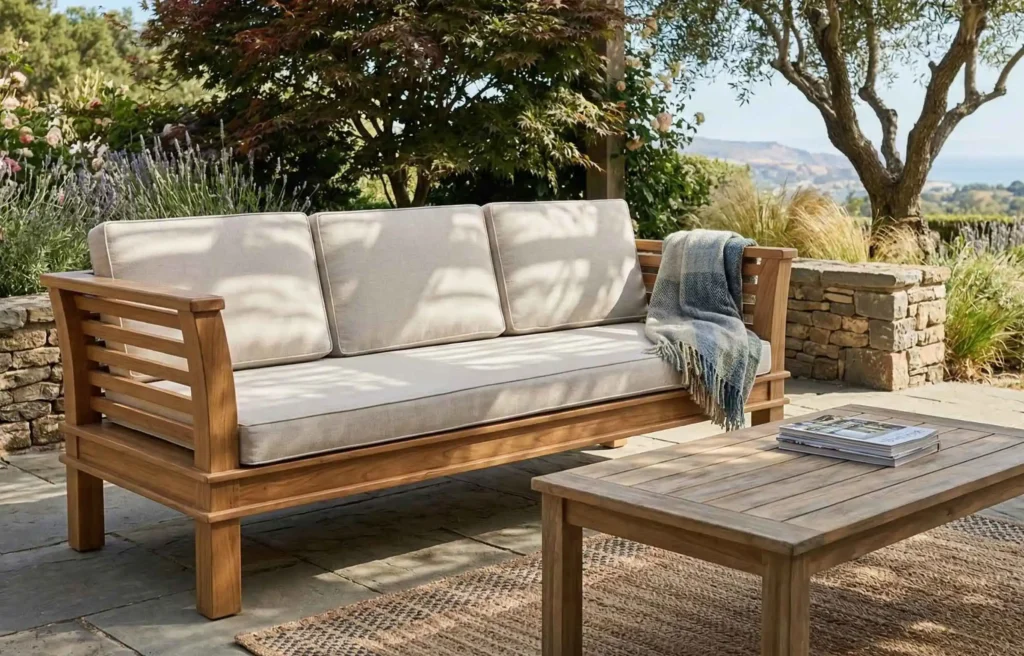
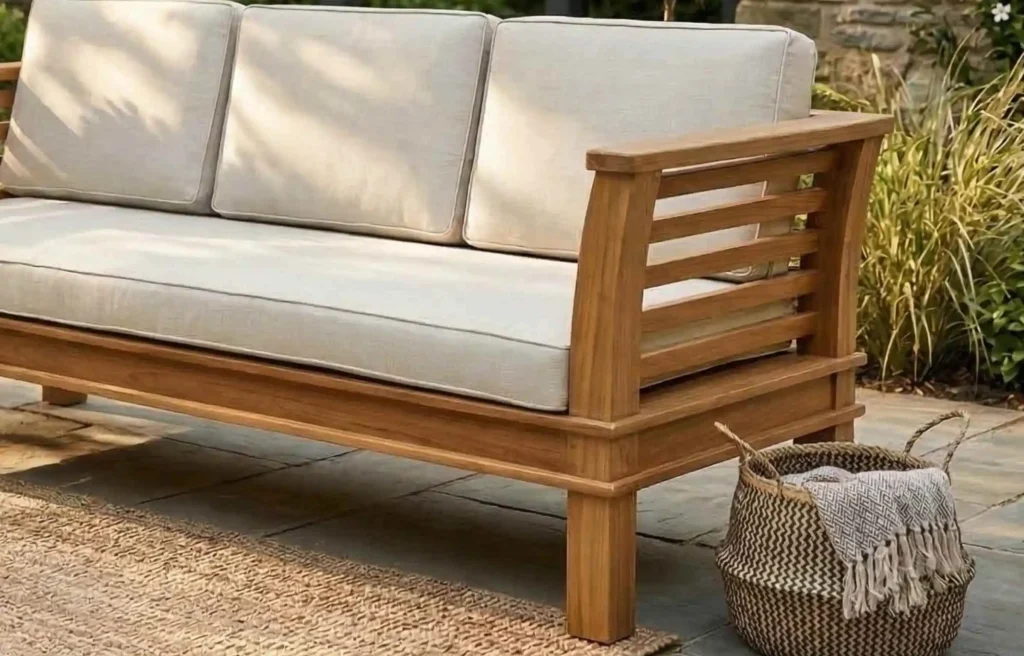
Teak sun loungers keep their recline mechanisms functioning correctly through years of heat exposure because the wood doesn’t warp around the hardware. The mechanism works on day one and still works on day one thousand. Outdoor sofa sets with solid teak frames give cushions a rigid, stable foundation season after season. No sagging. No frame twist.
Outdoor coffee tables and teak benches complete the setup. Benches especially have an extraordinary track record. Some teak benches in public parks across England have sat outside, uncovered, through rain, frost, and summer heat for well over a hundred years.
Moving that proven resilience to a poolside in Muscat or a courtyard in Jeddah is simply a matter of picking the right material and the right maker.
Maintenance in Hot Climates Takes Almost No Effort
This is the part that surprises people. They assume premium wood means premium upkeep. It’s the opposite with teak.
In hot, arid environments, the total maintenance routine comes down to occasional washing with mild soap and water to clear dust buildup. That’s it. No annual re-staining cycle. No stripping and re-coating. No replacing rotted synthetic straps. If sand collects in crevices after a storm, a soft brush handles it in minutes.
For hospitality operators, hotels, resorts, restaurants managing large terrace spaces, this maintenance simplicity translates directly into budget savings. The typical cycle for cheap outdoor furniture in harsh climates is replacement every two to three years.
Multiply that across fifty tables and two hundred chairs, and the numbers get ugly fast. A single investment in solid teak from Teakia eliminates that entire replacement merry-go-round. The upfront cost pays itself back several times over across a 30 to 50-year working life.
The Sustainability Argument Nobody Can Ignore
Furniture that lasts half a century generates dramatically less waste than furniture replaced every few years. Simple maths, massive environmental impact. The U.S. Environmental Protection Agency identifies furniture as one of the fastest-growing municipal solid waste categories.
Every disposable patio set that ends up in a landfill within five years adds to a problem that better material choices could prevent entirely.
Indonesian teak plantations operate under government-regulated replanting programmes. Trees grow in managed cycles. Forests regenerate. The World Wildlife Fund actively advocates for plantation-grown timber as a strategy to reduce logging pressure on wild forests. Teakia’s outdoor furniture uses teak from exactly these kinds of sustainably managed sources.
Buying a teak dining set that stays in service for thirty years instead of cycling through six disposable sets over the same period isn’t just a financial decision. It’s an environmental one. And the gap between those two choices widens further in extreme climates, where cheap materials fail even faster than they do in milder conditions.
The Real Maths on Cheap Versus Premium Outdoor Furniture
A plastic dining set costs a fraction of what teak does. Everyone can see that on the price tag. What the price tag doesn’t show is the total spent over ten years.
A budget outdoor set in a desert climate typically lasts two to four years before it needs full replacement. Factor in three replacements over a decade, plus the disposal hassle and delivery costs each time, and the total expenditure routinely exceeds what a single premium teak set would have cost upfront. The teak set, meanwhile, would still be in excellent condition at the end of that same decade. Probably still in excellent condition at the end of the next decade, too.
According to Statista, the global outdoor furniture market is projected to cross USD 62 billion by 2029. A growing share of that spending is consumers moving away from throwaway pieces toward investment-grade furniture.
The International Casual Furnishings Association reports that nearly 65% of buyers now weigh lifecycle costs and maintenance burden before purchasing outdoor furniture. The market is catching up to what arid-climate homeowners already knew.
Picking the Right Manufacturer Makes or Breaks the Investment
Teak’s natural properties only deliver their full potential when the manufacturing process respects the material. Sloppy kiln-drying creates internal stress that leads to cracking later. Poor joinery means loose frames within a year or two. Cheap stainless hardware corrodes in salt air. The wood might be genuine teak, but bad construction undermines everything.
What separates a reliable manufacturer from the rest comes down to a few specifics. Grade A heartwood only. Proper kiln-drying to the correct moisture content. Mortise-and-tenon or dowel joinery. Brass or marine-grade stainless steel hardware. And a construction philosophy that accounts for natural wood movement rather than fighting it.
Teakia operates as a manufacturer, wholesaler, and retailer from its base in Shah Alam, Malaysia, with direct ties to Indonesian teak plantations. That vertical supply chain, from forest to factory to showroom, keeps quality consistent across every piece.
Whether it’s an outdoor lounge chair, a full dining set, or a teak ottoman for daily poolside use, the construction standard stays the same. The Teakia showroom offers a chance to check that build quality firsthand before committing.
Teak Works Indoors Too – One Material Across the Entire Property
Something worth mentioning for anyone already investing in teak for their terraces and pool decks. The same material works beautifully inside. Teak dining tables and teak dining chairs create visual continuity between indoor and outdoor spaces. That design coherence matters in open-plan villas, resort properties, and modern homes where the boundary between inside and outside is deliberately blurred.
Teak sideboards, console tables, and bed frames bring the same warm grain and lasting durability indoors. For hot-climate properties where doors and windows stay open half the year, having furniture that handles humidity fluctuations and temperature shifts regardless of placement makes life considerably simpler.
Bottom Line for Buyers in Extreme Climates
Extreme heat cracks plastic. Sandstorms strip coatings off metal. UV radiation bleaches and degrades nearly everything the mass-market furniture industry produces. These aren’t edge cases. For hundreds of millions of people living in desert, arid, and tropical regions, these are the baseline conditions their outdoor furniture faces daily.
Teak doesn’t just survive those conditions. It was built for them by nature, long before any furniture designer got involved. The oils, the density, the tight grain, the silica, the dimensional stability. All of it evolved in tropical forests subject to intense heat, monsoon rain, and insect pressure.
Transferring those properties to a terrace in Dubai or a garden in Alice Springs is the easiest engineering decision in the furniture world.
Choose solid Grade A teak. Choose a manufacturer that sources responsibly and builds with traditional joinery. Then stop worrying about your outdoor furniture. It’ll outlast the house.
Browse the complete teak outdoor furniture range and invest in pieces that handle whatever the climate throws at them.




