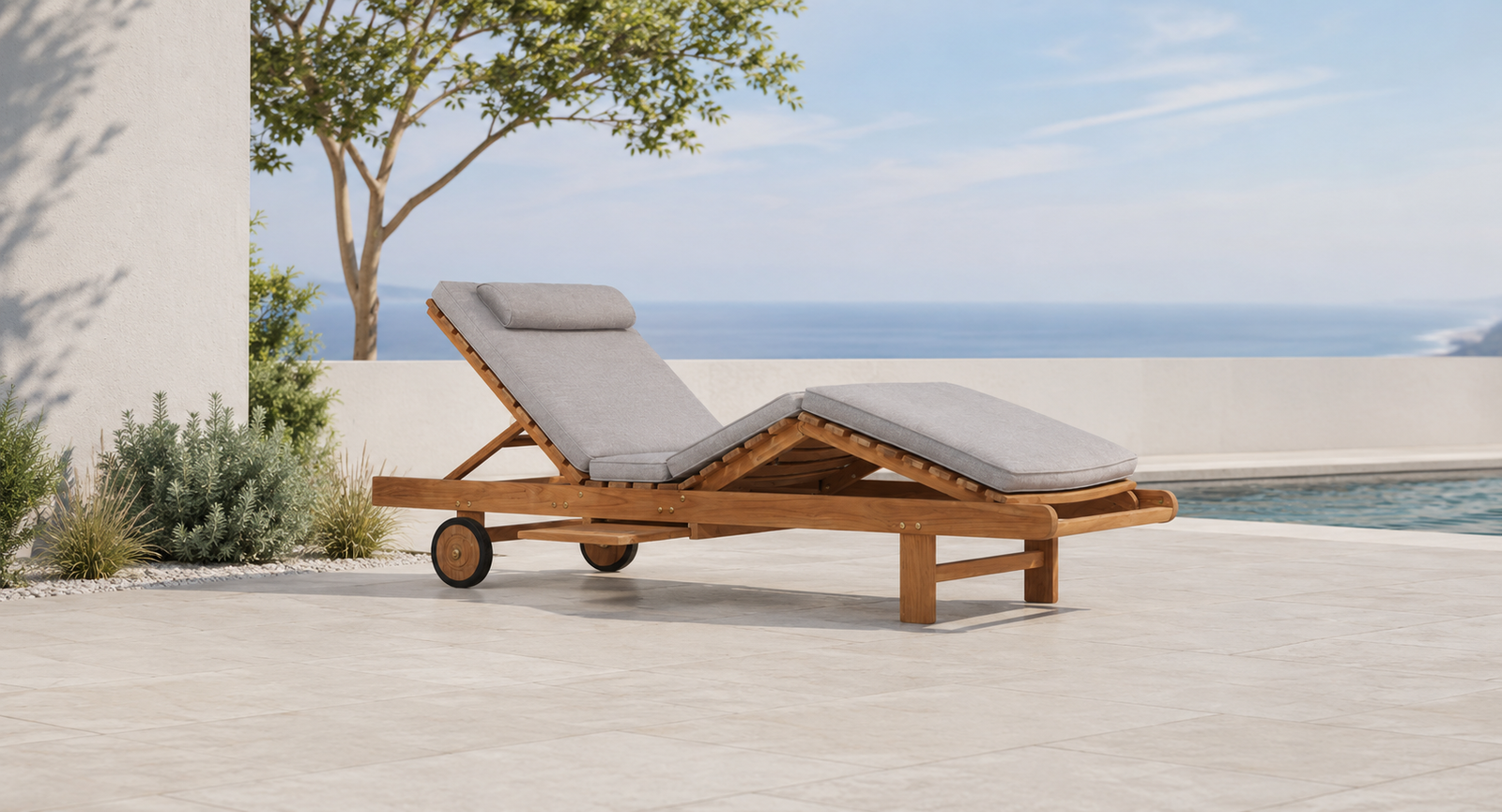
If you’ve ever stood in a furniture showroom, hand resting on a beautiful teak dining set, and thought — but will it survive our weather? — this post is for you.
The short answer is yes. But the longer answer is far more interesting, and knowing it will change how you think about outdoor furniture in Malaysia entirely.
Malaysia’s climate is unlike anywhere else on earth. We don’t have four seasons — we have sun, rain, and then more sun. Daily UV exposure is intense, humidity sits high year-round, and temperature swings, while not dramatic, happen consistently enough to matter at the material level.
Most furniture guides written for European or North American audiences are essentially useless here. They talk about storing furniture in winter and spring-cleaning your patio. None of that applies to us.
What applies is this: our climate is hot, wet, and relentless. For most materials — powder-coated aluminium, synthetic rattan, treated steel — that’s a real challenge over time. But for solid teak? It’s practically home.
The teak used in Teakia’s outdoor furniture comes from Indonesia — our immediate neighbour, sharing virtually the same equatorial climate we have here. Teak trees evolved in this environment. They grew in it for decades before being harvested. The wood carries a naturally high oil content and a tight, interlocked grain that gives it inherent resistance to moisture, insects, and rot in a way almost no other timber can match.
When people ask us whether outdoor teak furniture can be left outside year-round in Malaysia, our honest answer is: that’s exactly what it was designed for. The purpose of teak was always to be outdoors — in the sun, in the rain — to be enjoyed that way.
Here’s where we need to have an honest conversation, because teak left outside in Malaysia will change. It just won’t break.
The most visible change is the colour. Fresh teak has that warm, golden-brown tone that everyone falls in love with in the showroom. Left fully exposed to sun and rain, that golden brown gradually fades into a silver-grey patina.
This is the single thing that causes the most anxiety among new teak owners — and the most unnecessary worry.
For many people — particularly those who love a weathered, coastal aesthetic — the grey patina is actually the look they were chasing. For those who prefer to maintain the original golden tone, teak oil is your answer. Think of it like sunscreen: it slows the greying down considerably, but eventually the tan will come. The best practice is to lightly sand and re-oil after the rainy season, getting the furniture looking its best heading into sunnier months.
If your furniture is in a semi-covered area — under a pergola, extended roof, or beside a parasol — the pace of greying will slow significantly. Think of it like spending the day in the shade versus direct sun. The tan still comes, just more gradually.
The second thing people notice — and what drives the most worried calls to our showroom — is hairline cracks appearing in the end grain of the timber.
This needs to be stated clearly: hairline cracks in solid teak are not a sign of poor quality. If anything, they are proof you have the real thing.
Unlike plywood, MDF, or compressed wood, solid timber is a natural material that breathes with its environment. It expands in heat and humidity, contracts when temperatures drop. Over time, especially in the end grain where wood fibres are most exposed, small surface cracks can appear. They are purely cosmetic. They have no effect on the structural integrity of the piece.
When customers call us about these cracks, we actually take it as a good sign — it tells us they bought genuine solid teak, not a compressed or engineered wood product pretending to be solid. We reassure them, and when needed, we bring the piece into our workshop, fill those cracks, sand it smooth, and return it looking better than the day it left.
Here is the part that genuinely surprises most people when we tell them.
That full silver-grey patina — the one that makes furniture look “gone” or “ruined” to the untrained eye? It is only the surface. A light sanding is all it takes to reveal the original golden teak underneath, completely intact.
At our workshop in Shah Alam, the refurbishment process is straightforward: we start with a coarser grit sandpaper and work progressively up to 200 grit to achieve a smooth surface, then finish with either a quality teak oil or a varnish depending on what the customer prefers. The result is a piece that looks brand new.
Customers who bring in ten-year-old pieces that have sat fully exposed in their gardens walk out with something that looks like it just came off the showroom floor. Teak does not expire. It just needs a little attention from time to time.
Yes, to some extent — but perhaps not in the way you’d expect.
A sun lounger on a beachfront property in Langkawi — fully exposed to salt-laden sea air, intense coastal UV, and direct rainfall — will weather faster than a dining set tucked under a covered patio in a KL suburb. A high-rise balcony in Penang brings its own variables: wind exposure, angled rain, and salt air that changes by floor level.
But here’s the consistent truth across all of those scenarios: the teak itself will not fail you. The pace of greying and the frequency of maintenance may vary by location, but the fundamental durability of the wood holds everywhere in Malaysia.
You don’t buy teak furniture in Malaysia looking to replace it in two years. You buy it because you want it for a decade or more — and it will deliver that, whatever corner of the country it ends up in.
We as people love the luxury of not having to do anything. And the good news is, with teak, you can largely get away with that.
That said, if you want to slow down the greying and reduce how often you need to maintain the wood, a furniture cover is your most effective tool. It keeps the worst of the direct UV and heavy rain off the surface, buying you considerably more time between oiling sessions.
If budget is a concern, an affordable waterproof tarpaulin does the job perfectly well — it’s not the neatest look, but it’s functional and inexpensive. If you want something that looks more intentional, custom-fitted outdoor furniture covers are available and add a neater finish to the setup.
The honest reality: most people buy covers with good intentions and use them inconsistently. That is fine. Teak will forgive you.
If your outdoor garden furniture in Malaysia includes cushions — and most setups do — the rule is refreshingly simple: get the right cushion and leave it be.
A quality outdoor cushion built with quick-dry foam and a proper outdoor-grade fabric does not need to be brought inside every time it rains. Malaysia’s weather actually works in your favour here — the sun returns so quickly after rain that everything dries fast. Wash them periodically, and that is genuinely all the maintenance required.
The problem arises only when people use cushions that aren’t actually designed for outdoor use — standard upholstery foam and untreated fabric simply aren’t built for daily UV exposure and rain cycles. Invest in the right materials at the start and you won’t have headaches later.
It is worth looking at how commercial operators approach this question — because they deal with it at scale, every day, without the option of bringing anything inside.
Hotels and resorts across Malaysia leave their poolside and beachfront furniture out year-round. Walk past any resort pool in the country and you will see teak sun loungers sitting in direct sun, paired with a parasol for shade. No nightly storage. No seasonal covers. Fully exposed, fully operational.
The difference between commercial and residential is not about what the furniture can handle — it’s about replacement cycles. Hotels swap furniture more frequently, not because it fails, but because foot traffic accelerates surface wear and hospitality trends demand refreshed aesthetics. Their maintenance schedules are more structured, and their budgets account for periodic refurbishment as a planned cost.
For hotels, developers, and project managers looking for a reliable contract furniture supplier in Malaysia, the durability of teak in outdoor conditions is always near the top of the specification brief — and it consistently delivers.
Outside our showroom in Hicom-Glenmarie, Shah Alam, there is a teak bench. It sits outside every day — fully exposed to sun and rain — and comes in only when we close for the night.
It is there on purpose.
Customers who visit can see exactly what happens to teak over time, in real Malaysian conditions, with no filters and no showroom lighting. The colour shift is visible. The patina develops gradually. Every so often, when we feel the piece has done its job as a demo, we sell it at a discounted rate and put a newer piece out there to start the process again.
It is our most honest product demonstration — and the most convincing thing we can show anyone who asks whether outdoor furniture can handle Malaysia’s weather.
The purpose of teak has always been to live outdoors — in the sun, in the rain, to be enjoyed that way. Invest in a quality set from a manufacturer you trust, and here is the most honest thing we can tell you after more than two decades in this trade:
Visit our showroom in Hicom-Glenmarie, Shah Alam, or explore our full range of solid teak outdoor furniture online. Built to last. Made to impress.