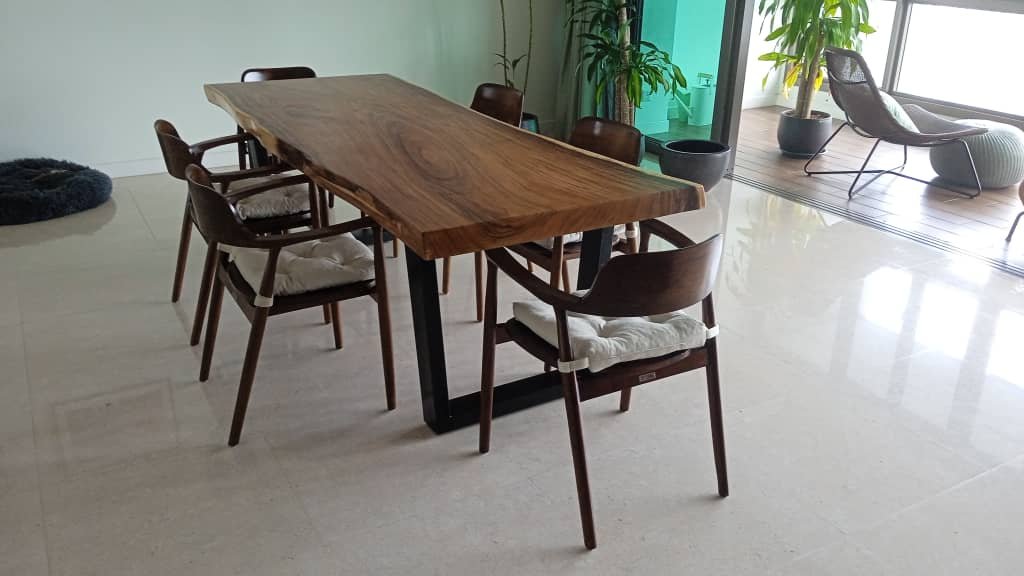
Short answer: To choose a dining table and chairs set in Malaysia, start with how many people live in your home and add two — that is the number of seats you actually need every day. Match the table length to your room (180cm, 210cm or 244cm covers most homes), pick a solid wood top over veneer because it survives daily wear and can always be refinished, and choose chairs with a wooden seat and a removable cushion so nothing becomes unusable when a cushion wears out. Buy from an established maker with a real warranty, and a good solid teak set will last you decades. Everything below explains the “why” behind each of these decisions.
A dining table is one of the very few things you buy once and expect to keep for decades. Yet most people spend more time choosing a sofa or a TV than the surface their family gathers around three times a day. This guide walks you through how to choose a dining table and chairs set in Malaysia the way a furniture manufacturer would — based on how these pieces are actually used, and where they actually fail.

The hardest-working piece of furniture in your home
Before you think about style or size, it helps to be honest about how much work a dining table really does. It is not just where you eat. It is where the kids finish their homework, where a parent answers emails, where the family has its serious conversations, and where the household bills get sorted at the end of the month. Breakfast, lunch and dinner every single day on top of all of that.
This matters because it changes how you should budget for it. Most people shop for a dining table as if it were decoration — something that needs to look nice in the room. In reality it is the single hardest-working surface in the house, closer to a kitchen counter than to a decorative side table. When a set disappoints a buyer, the reason is almost always the same: they chose it for how it looked in the showroom, and it could not keep up with how hard real life uses it. It failed faster than they expected. So the first rule of choosing well is simple — buy it thoughtfully, and buy it to work hard.
How many seaters do you actually need?
This is where the most common mistake happens, and there is a simple formula that fixes it. Count everyone who actually lives in the home — parents and children included — and add two. That is the seat count you need for everyday life.
Two examples make it clear:
- 2 parents + 2 kids = 4 people. A 6-seater is comfortable and future-proof.
- 2 adults + 3 kids = 5 people. Plus two is seven — an odd number, so round up to an 8-seater.
The big trap is sizing for the wrong days. People imagine the one or two parties a year when 10 to 20 guests come over, and they buy an enormous table for it. Don’t. Size for the other 360 days when it is just your household using it. A table that is too big for daily life is a daily inconvenience; the occasional big gathering can always spill onto extra seating.
Once you know your seat count, match it to your room — and here is something most buyers never realise: a “6-seater” is not one fixed size. The same seat count can be tight or generous depending on the table’s length.
| Table Length | What It Comfortably Seats |
|---|---|
| 180 cm | A tight 6-seater |
| 210 cm | A comfortable 6-seater, or a tight 8-seater |
| 244 cm | A comfortable 8-seater |
These are the three standard sizes we make at Teakia, and they cover the vast majority of Malaysian homes. If you fall between sizes or have an unusual space, a custom size can always be made — it simply takes a little extra production time. You can see the full range on our dining table Malaysia collection.
Why an indoor dining table faces a tougher test than an outdoor one
This surprises almost everyone. We assume the outdoors — sun, heat, rain — is the enemy of wood. But for a dining table, the harsher environment is usually indoors, and the culprit is air conditioning.
Think about what an outdoor teak table experiences. Temperatures might swing from 28–29°C at night up to 38°C on a hot afternoon. That is a real change, but it happens slowly, over many hours. The wood has time to adjust. Indoors, the story is very different. A room can drop from 38°C to 22°C within 15 to 20 minutes when the aircon comes on, then climb back to 35–36°C once it is switched off. That rapid expansion and contraction is far more stressful for wood than a gentle outdoor drift.
Here is the honest part, and it is important: with solid wood, this can occasionally cause very minor movement or fine hairline marks. This is completely normal. It is the wood breathing and responding to its environment — a sign of genuine, natural material, not a sign of poor quality or a defective table. Most of the time it never becomes an issue at all. And it is absolutely not a reason to choose fake wood over real wood. You can manage it easily by keeping the table out of the direct blast of an aircon unit and letting a new piece settle into the room. Real wood lives and adapts; that is part of owning something authentic.
Where cheap dining sets fail first (and the truth about veneer tops)
If you want to judge quality, it helps to know where cheap sets break down. On an inexpensive dining table, the damage shows up on the top first. Regular use brings yellowing — the natural oils from our hands and skin build up over time. The table starts to wobble. And after just a year or two, the whole thing simply looks like an eyesore.

Which brings us to a strong opinion, honestly held after two decades of making furniture: veneer does not belong on a table top. Not on a dining table, not on a coffee table, not on a side table. These are the highest wear-and-tear surfaces in the whole house. The single repair that saves a worn top is sanding and refinishing — and veneer can only be sanded a couple of times before you cut straight through the thin top layer and expose the substrate underneath. The one fix that matters most is the one veneer cannot survive.
To be fair, veneer has its place in furniture — there are parts of a piece where it makes perfect sense. Table tops just aren’t one of them. Given the choice, a solid wood top wins every time: yes, it adapts and changes with its environment, and yes, it may carry a few minor natural marks — but when the real test of daily life comes, solid beats a flawless-looking veneer that quietly wears through. Solid wood you can always bring back. Veneer, you cannot.
How to choose the chairs
The chairs deserve just as much thought as the table — you want a set that lasts decades and still looks right years from now. A few principles make that far more likely.
Choose a wooden seat with a removable cushion on top. This is the advice we give almost every client. No matter how good or how expensive a dining chair is, the moment a built-in, non-removable cushion gets dirty or the foam gives out, that entire chair is essentially finished. A wooden seat solves this. If you want extra softness, add a loose cushion on top — and now you have flexibility for life. You can wash it, and you can change its colour every few years to refresh the whole dining room. The chair lasts decades; the cushion is replaceable. You never tie the lifespan of an expensive chair to the lifespan of a cheap piece of foam.
Treat armrests as a space decision, not just a comfort one. Some people love armrests, others don’t — that part is personal. But arms also take up width and can stop chairs tucking neatly under the table. In smaller Malaysian dining spaces, armless chairs are often the more practical choice.
Skip the cheap plastic chair. It feels like the easy, wallet-friendly choice, and for a short while it is. Long term, it is a false economy — it fails quickly and looks cheap almost as fast. Choosing a solid, lasting material saves you money across the years, and it simply results in a dining room you are proud of. (As a small bonus, we already have enough plastic in the world — there is no need to make furniture out of it when better options exist.)
Matching your table and chairs
Buyers often stress about whether the chairs must match the table perfectly. They don’t. The chairs and table simply need to look good together as a pair — coherence matters, not identical wood.
This is one of teak’s quiet advantages. Because it is all the same wood, you can pair almost any teak table with almost any teak chair and get a harmonious result — we just match the stains so the tones sit well together. That is the flexibility we offer at Teakia: mix and match table and chair models freely, without worrying that they will clash. If deciding feels like too much, a pre-matched set exists precisely to take that decision off your plate — you pick one set and know it works together.
One thing to be careful of: buying several different chair designs for the same table — say six chairs across four or five different styles — usually reads as a mistake rather than a choice. Some brave souls do it deliberately for an eclectic, industrial look, and that is entirely subjective. But for most homes, a clean and coherent set is the safer, better-looking default.
What a solid teak dining set really costs
Let’s be straightforward about price. Teak is a luxury solid wood, and it is priced accordingly. That does not mean it is out of reach for the average buyer — it simply means it is a big, considered purchase rather than an impulse one.
As a rough guide, a simple 6-seater teak dining set at Teakia typically starts around RM8,500, depending on the design. Some styles cost more, but that is the ballpark — and that set is built to last decades. You will find teak dining sets advertised more cheaply online and elsewhere, and we can’t speak to what others are actually selling or how it is made. What you get from an established maker is certainty: real, known material and an actual warranty behind it.
Now put that next to the maths of a cheap set. If an inexpensive table becomes an eyesore in a year or two and gets replaced two or three times over the same period a teak set lasts, the “cheaper” option often costs more in the end — and delivers far less along the way. Measured by cost per year of use, quality solid teak is frequently the better value, not the extravagance it first appears to be. You can learn more about how and where we make our furniture on our furniture manufacturer Malaysia page.
How to check quality before you buy
Whether you are standing in a showroom or shopping online, there is a short checklist that tells you most of what you need to know. It splits into two parts — judging the product, and judging the seller.
Judging the product — ask the salesperson directly about:
- The quality of the wood and roughly how old the tree was. Older, slower-grown timber is denser and more stable — good teak sits around 650–700 kg/m³.
- The quality of the finish — it should feel even and well-applied.
- The warranty — a real one signals a maker who stands behind the piece.
- Whether any sapwood is used. This is the insider question most buyers never think to ask. Sapwood is the younger, outer part of the tree — softer, less durable and more prone to problems than the dense heartwood you actually want in a teak table. A good maker welcomes this question; a poor one dodges it.
Judging the seller — especially when buying online, check:
- How many years the company has been operating.
- Their reviews — genuine, and enough of them to matter.
- Real photos of actual deliveries, not just polished catalogue renders.
- A legitimate, well-kept website that confirms they are a real, reputable business.
In a market where anyone can list a “teak” set online, these questions are your filter. They also quietly reveal the difference between an established manufacturer with a real showroom and a review history, and a nameless listing you can’t verify. The same standards apply if you are furnishing at scale — hotels and resorts sourcing through our contract furniture supplier service ask exactly these questions before they commit.
Living with your dining set: care that’s genuinely easy
Here is some reassuring news for anyone worried that solid wood means constant maintenance. For the first couple of years, you do almost nothing. Normal cleaning with a damp cloth, a few coasters, common-sense care — that is genuinely all it needs. No oiling rituals, no anxiety.
Even when wear and tear eventually begins to show, it takes a very long time to become noticeable. And when that day finally arrives, it is not a problem — it is a scheduled refresh. Give us a call and we will bring the piece back to life. And if you can’t reach us, any competent woodworker or anyone who finishes tables can restore it too. That is the real beauty of solid wood, and of solid teak in particular: you can always bring it back. This is exactly what veneer cannot do — and it is the whole reason a solid set survives the test of decades.
The real goal: buy once, buy well
When clients come to us, they tell us the same thing again and again: the reason they are buying teak is because they want it to last a very long time. We want exactly the same for them. And the quiet proof that it works is that those same clients come back to us years later — for another piece, for their next home, for a family member. When that happens, we know we did the job right.
So if you take one thing from this guide, let it be this: a dining table and chairs set is the hardest-working furniture you own. Choose the set built to survive the real test — the right size for your everyday life, a solid top you can always restore, chairs whose cushions you can replace, from a maker who stands behind their work. Do that, and you buy it once. Beyond dining, the same thinking applies across your home — from outdoor furniture in Malaysia to garden furniture that lives outside year-round.
Frequently asked questions
What size dining table do I need for a family of four?
Take the number of people living in your home and add two. A family of four therefore needs a 6-seater. In table length, a 180cm table is a tight 6-seater and a 210cm table is a comfortable one, so a 180–210cm table suits most families of four.
Is a teak dining table good for Malaysia’s climate?
Yes. Teak is one of the most stable and durable woods for our climate. The main thing to know is that rapid indoor temperature swings from air conditioning stress wood more than gradual outdoor heat, so keep the table out of an aircon unit’s direct blast. Any minor natural movement is normal wood behaviour, not a defect.
Should I choose a solid wood or veneer dining table top?
Solid wood, for a table top. A dining table is a very high wear-and-tear surface, and a solid top can be sanded and refinished many times to bring it back to new. Veneer can only be refinished once or twice before the thin top layer wears through and exposes the material underneath.
How much does a solid teak dining set cost in Malaysia?
A simple 6-seater teak dining set typically starts around RM8,500 at Teakia, depending on the design. It is a considered purchase, but because a solid teak set lasts decades, its cost per year of use is often lower than a cheap set that needs replacing every few years.
Do the dining chairs need to match the table exactly?
No. The chairs and table only need to look good together as a pair. With teak, we simply match the wood stains, so you can pair almost any teak table with almost any teak chair. Choosing chairs with a wooden seat and a removable cushion is the smartest choice for long-term durability.
Ready to choose a dining set built to last decades?
Visit our Shah Alam showroom to see and feel our solid teak dining tables and chairs in person, or message us and we’ll help you pick the right size and set for your home — no pressure, just honest advice from the people who make it.
WhatsApp Us
Browse Dining Tables
Teakia by Ashiana Industries (M) Sdn Bhd — No. 29, Jalan Pendidik U1/31, Hicom-Glenmarie Industrial Park, 40150 Shah Alam. Showroom open daily, 10am–7pm.