TL;DR — Quick Answer
Solid teak is the only outdoor dining table material that genuinely thrives in Malaysia’s climate — not just survives it. Its natural oil content repels rain, resists rot, and handles UV without structural damage. For maximum longevity, pair a teak top with powder-coated aluminium or stainless steel legs. Everything else — plastic, cheaper woods, aluminium alone — degrades faster than most people expect.
If you’re wondering what outdoor dining table materials are weatherproof in Malaysia’s climate — the short answer is: not many of them, and certainly not equally. The afternoon sun hits hard, the rain comes without warning, and the humidity never really lets up. The material you choose for an outdoor dining table isn’t just an aesthetic decision. It’s the difference between a table that survives a few seasons and one that genuinely thrives for decades.
There’s a real difference between surviving and thriving. After 20 years of manufacturing and supplying outdoor furniture in Malaysia at Teakia — teak furniture Malaysia, we’ve seen both ends of that spectrum up close.
Here’s an honest look at the main materials — what they can handle, what breaks them down, and which one we’d put in our own garden.
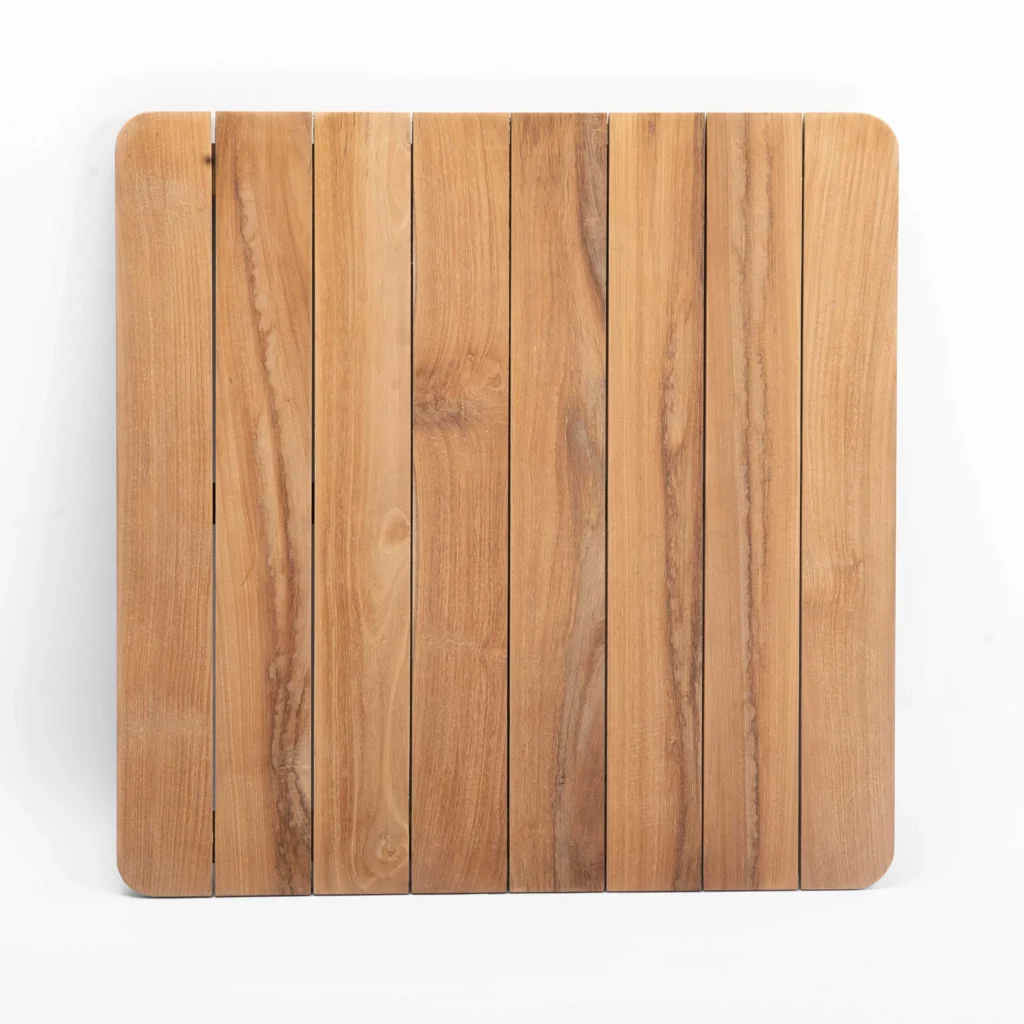
Teakia solid teak outdoor dining table — built for Malaysian weather.
The Main Materials for Outdoor Dining Tables
1. Solid Teak — Thrives
Teak is not just a good outdoor wood. Teak wants to be outdoors. It originated in the tropical forests of Southeast Asia — it evolved in exactly the kind of heat, rain, and humidity that Malaysia delivers year-round. That’s not marketing language. That’s biology.
The reason comes down to one thing: its naturally high oil content. That oil repels water at the wood level, stopping moisture from penetrating the grain. No moisture penetration means no rot, no warping, and no structural weakening over time. Where other woods absorb the rain and slowly give up, teak sheds it and carries on. It’s why we use it as the material of choice for every dining table we manufacture.
What about the sun? Teak turns silver-grey over time when left untreated outdoors. This is UV doing its work on the surface — it doesn’t affect structural integrity at all. Many people prefer the weathered grey look. If you want to keep the original warm golden-brown tone, a light sand and oil once or twice a year is all it takes.
Small surface cracks can occasionally develop in high humidity — particularly if the wood wasn’t properly kiln-dried. At Teakia, as a furniture manufacturer in Malaysia, all our teak is kiln-dried, which stabilises the wood significantly. And if minor cracking does occur, it’s cosmetic only — it doesn’t affect the table structurally.
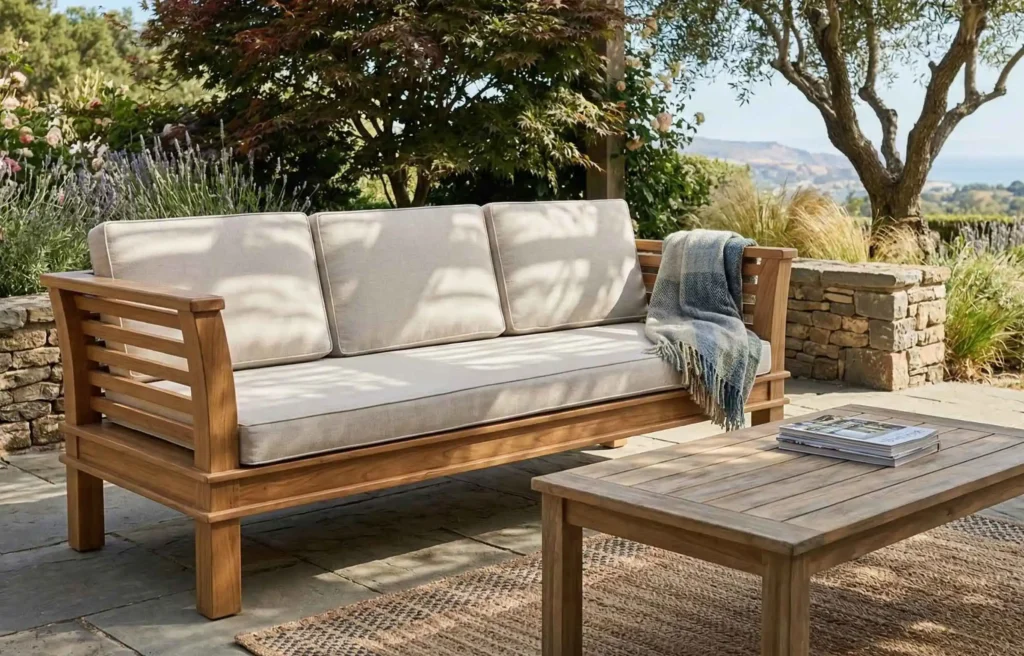
Solid teak develops a natural silver-grey patina outdoors — structural integrity unaffected.
2. Powder-Coated Aluminium — Survives
Powder-coated aluminium is a legitimate outdoor material — lightweight, rust-resistant, and it doesn’t rot. For a fully exposed outdoor setting, it holds up reasonably well short to medium term.
The limitation is the powder coating. Malaysia’s UV causes colour to fade — not dramatically in year one, but noticeably by year three or four. And unlike teak, which you can sand back and re-oil, a faded or scratched powder coat is difficult to restore. Once damaged, it tends to stay that way. Realistic lifespan: 5–6 years before it looks noticeably worn.
3. Stainless Steel — Survives
Stainless steel is durable and rust-resistant. It’s commonly used for outdoor furniture frames and legs — holds structural integrity well, doesn’t warp, and is easy to clean. The downside in Malaysia: it gets extremely hot in direct sunlight and can develop surface oxidation in coastal areas over time. As a frame paired with a teak top, stainless steel is an excellent combination. As a standalone table material, it has limitations.
4. Plastic — Not Recommended
Plastic outdoor furniture is affordable and requires no maintenance — until the UV does its work. In Malaysia’s climate, plastics degrade visibly within 2–3 years. Colour fades, surfaces become brittle, structural integrity weakens. It’s a temporary solution, not a permanent one.
5. Cheaper Woods (Acacia and Similar) — Survives Briefly
Acacia is often positioned as a teak alternative at a lower price. And in the beginning, it can look the part. But it doesn’t have teak’s oil content — and that difference shows up quickly outdoors. Within a few seasons of Malaysian weather, acacia tends to crack, split, and lose structural integrity. The gap between teak and cheaper woods isn’t visible when you buy. It becomes obvious two years later.
At a Glance
How the Materials Compare
| Material | Rain | UV / Sun | Maintenance | Lifespan |
|---|---|---|---|---|
| Solid Teak | Repels naturally | Greys gracefully | Oil 1–2x per year | 25+ years |
| Powder-Coated Aluminium | Good | Fades over time | Not recoverable if scratched | 5–6 years |
| Stainless Steel | Good | Good | Minimal | 8–10 years |
| Plastic | Adequate | Fades and brittles | None | 2–3 years |
| Cheaper Woods | Poor long-term | Poor | High | 3–5 years |
Estimates based on typical Malaysian outdoor conditions. Actual performance varies with placement, exposure, and care.
Covered Patio vs Fully Exposed — Does the Material Change?
If your dining table sits under a pergola or covered patio, you have more flexibility. The table is still exposed to ambient humidity and indirect weather, but protected from direct rain and the worst of the afternoon sun.
In that context, a mix of materials works well — a solid teak top with powder-coated aluminium or stainless steel legs is both practical and visually clean. Many of our garden furniture pieces are built exactly this way.
For fully exposed outdoors — no cover, direct sun, direct rain — teak is always the answer. It’s the only natural material in this category built for exactly those conditions. It’s also why teak is the default choice for hotels and resorts — see our contract furniture supply page for hospitality projects.
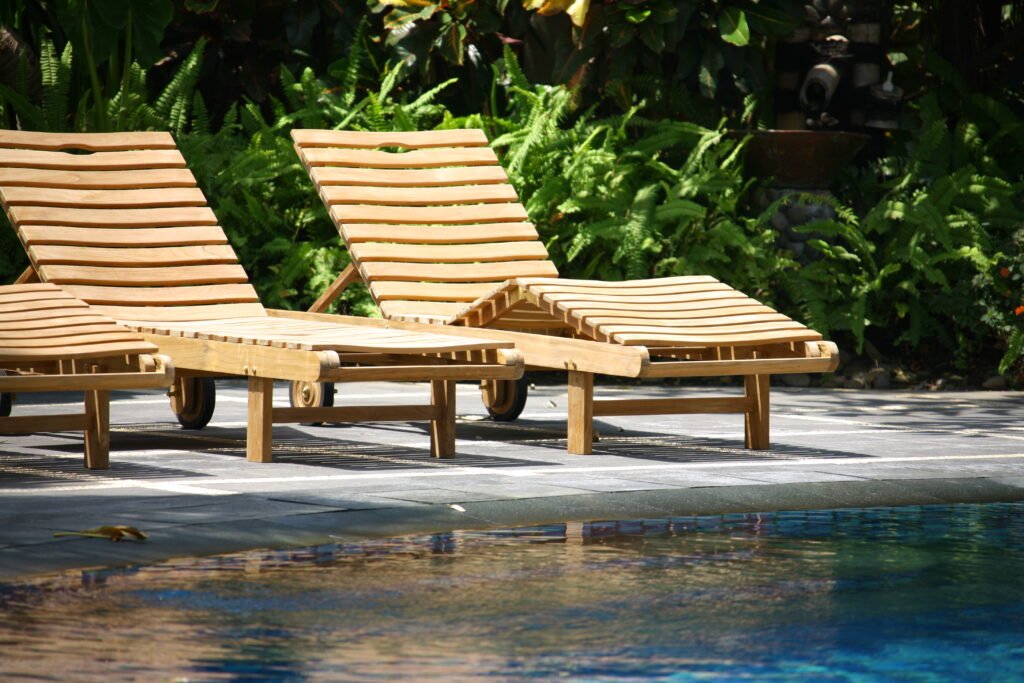
Teak top with aluminium base — a practical combination for covered outdoor settings.
The Most Weatherproof Outdoor Dining Table
If someone came to us and said “I want the most weatherproof outdoor dining table, I don’t want to think about it again” — we’d be honest: there’s no such thing as completely zero-maintenance outdoor furniture.
Think about your phone. It’s a technological marvel — engineered to extraordinary tolerances. And yet you still put a screen protector on it, replace the case when it cracks, wipe it down occasionally. The same principle applies here. The goal isn’t to find something that never needs care. It’s to find something where the care required is minimal and the lifespan justifies it.
Our recommendation: a solid teak top with powder-coated aluminium or stainless steel legs. If you’re happy to let the teak go grey, you may not need to touch it at all. If you want to maintain the original colour, one oiling session a year keeps it exactly as it looked when it arrived. That’s the full ask for a table that will still be in your garden 25 years from now.
Get in Touch
Ready to Choose Your Outdoor Dining Table?
Visit our Shah Alam showroom to see the materials in person, or get in touch and we’ll help you find the right table for your space.