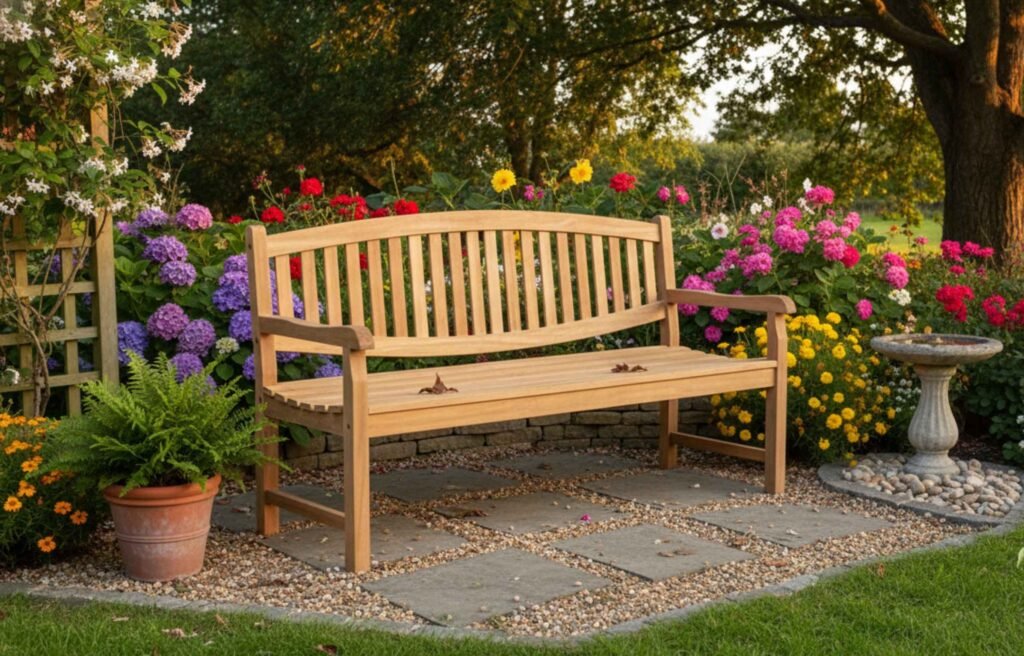
How long does an outdoor bench last? It depends entirely on what it is made of — and the honest answer is that a solid teak outdoor bench will easily last over 20 years, longer than most cars, with none of the maintenance a cheaper bench needs. This guide explains why teak outlasts every other outdoor bench material, what we have actually seen after 15 years of deliveries, and how to spot the real thing.
Quick answer: A solid Grade-A teak outdoor bench lasts 20+ years outdoors with zero treatment. Metal rusts and scorches, plastic cracks within a few years — teak’s natural oils and dense grain resist rot, water and termites on their own, with no varnish or cover needed.
What We Have Actually Seen After 15 Years
Most articles quote a lifespan. We can tell you what we have watched happen to real outdoor benches, because we have been making and delivering teak furniture for over 20 years. So how long does an outdoor bench last in practice? Here is what two decades of deliveries have shown us.
Pieces we supplied come back to us for light maintenance after 15 years — to be refreshed, not replaced. That distinction is the whole point: after a decade and a half outdoors, the wood is still sound enough to be worth restoring rather than thrown away.
The solid teak outdoor bench outside our own shop has sat in full, uncovered sun and rain for 2+ years and still looks great. And the outdoor garden benches we supplied to Subang Park Homes apartments roughly 5 years ago are still in daily use by residents today. These are not lab claims — they are benches you could go and sit on right now.
What Is the Best Material for an Outdoor Bench?
Every outdoor bench is a bet against sun, rain and humidity. The material decides whether you win that bet for 20 years or a couple of seasons. Teak wins it because the protection is built into the timber itself — not sprayed on afterwards.
Natural oil content. Teak is naturally rich in oils and silica. These repel water from the inside, so rain sits on the surface instead of soaking in and rotting the fibres. This natural oil is the single biggest reason a teak outdoor bench survives decades of Malaysian rain untreated. It is the same property that makes teak the traditional choice for boat decks and marine use.
High density. Teak is a dense, tight-grained hardwood. There is very little open space in the wood for water to penetrate or for the timber to warp and crack the way softwoods do in the sun.
Naturally termite-resistant. Those same oils make teak unappealing to termites and wood-boring insects — a real advantage in a tropical climate where cheaper woods get eaten from the inside out.
Kiln-dried to 12% moisture. Before it is ever built, our teak is kiln-dried to a moisture content of around 12%. This stabilises the wood so it does not shrink, swell or crack the way improperly dried timber does when it meets Malaysian humidity. Durability starts before the bench is even assembled.
Put together, this is why teak is widely considered the best material for an outdoor bench: it does outdoors, untreated, what other materials can only do with constant upkeep and still lose. And because it is real solid wood rather than a composite of glued materials, there are no layers to peel, delaminate or break down over time.
How Long Does an Outdoor Bench Last Over 20 Years?
Here is the part that surprises people. Left outdoors, teak slowly changes colour — from its original warm golden-brown to a soft, silvery grey. This is completely normal and, importantly, it is not damage.
How fast? On a bench left completely uncovered in the sun, expect the full silver-grey to develop over roughly 6 to 12 months. If the bench is covered or semi-covered — under a patio roof, a balcony, or partial shade — the results vary and the change is slower and more uneven.
The grey is purely cosmetic. It is a surface patina caused by sunlight and weather, and it does not weaken the wood underneath at all. The bench is just as strong at year 20, grey, as it was golden on day one. Many people actively prefer the weathered grey look — it reads as calm, natural and established in a garden.
So the honest answer to “will it go grey?” is: yes, and you get to decide whether that is a feature or something to reverse. It is entirely subjective. Enjoy the grey, or bring the gold back — which brings us to the next question.
How Do I Restore the Golden Colour?
If you prefer the original golden tone, restoring it is simple: lightly sand the surface. Sanding removes the thin grey patina layer and reveals the fresh golden teak underneath. That is the whole process — no stripping chemicals, no specialist skill.
Our recommendation: start with 120 grit and work your way up to 240 grit maximum. Doing a whole bench by hand takes about an hour. That is the entire job — no sealants or coatings needed afterwards, because the teak protects itself.
How often you do it is up to you. Some owners sand once a year to keep the gold; others never touch it and let the grey settle in permanently. Neither is wrong, and neither affects how long the bench lasts. It is a purely aesthetic choice, and the fact that you can reset the colour with sandpaper alone is a quiet advantage of genuine solid teak — there is fresh wood all the way through, not a coating over something cheaper.
How Can I Tell If It Is Real Grade-A Teak?
This matters, because “teak-coloured” furniture and teak veneer over cheaper wood are sold everywhere, and they will not last 20 years. Three checks help you tell a genuine solid teak outdoor bench from an imitation:
Look at the colour. Real teak has a consistent warm golden-brown tone through the piece, not a painted-on uniform finish.
Look at the grain. Genuine teak shows natural, flowing grain lines. Printed or veneered surfaces repeat or look artificially perfect.
Use the sandpaper test. This is the honest one. Lightly sand a small area. On solid teak, what is underneath is simply more teak — same colour, same grain. On a disguised piece, sanding reveals a different, cheaper wood or a glue line under the surface coating.
A telling sign of an honest maker: how they finish the bench. A genuine solid teak bench does not need a thick lacquer to look good, because there is nothing to hide beneath it. What you see on the surface is what the whole bench is made of — no coating covering an inferior core. It is worth insisting on Grade-A teak specifically, as it is the highest grade, cut from the mature heartwood where the protective oils are richest.
Teak vs Metal vs Plastic: The 20-Year View
Cheaper outdoor benches are tempting on price, but the ownership experience over time is where the difference shows. Here is how the common outdoor bench materials compare across two decades of Malaysian weather:
| Material | In the sun | Over time | Lifespan |
|---|---|---|---|
| Metal | Heats up — can get too hot to sit on | Rusts and stains without constant care | Varies widely |
| Plastic / HDPE | Stays cool but fades | Discolours and can grow brittle and crack | A few years typically |
| Solid Teak | Comfortable, does not scorch | Greys gracefully; sand back to gold anytime | 20+ years |
Metal heats up in the sun. Plastic discolours and eventually cracks. A teak outdoor bench shows up today, tomorrow, next year, and 20 years into the future — still comfortable, still strong. When quality teak is available at a fair price, the cheaper option often ends up costing more, because you replace it several times over the life of one teak bench.
So when you ask how long does an outdoor bench last, the honest answer comes down to one word: material. In solid teak, the answer is decades — in almost anything else, a few short years.
Frequently Asked Questions
How long does an outdoor bench last?
It depends on the material. A solid Grade-A teak outdoor bench easily lasts over 20 years with no treatment, while metal and plastic benches last far less. In our own experience, teak pieces come back for light maintenance after 15 years — to be refreshed, not replaced.
What is the best material for an outdoor bench?
Solid teak. Its natural oils repel water, its dense grain resists warping, and it is naturally termite-resistant — so it survives outdoors untreated for 20+ years. Metal rusts and scorches in the sun, and plastic discolours and cracks within a few years.
How long does teak take to turn grey?
On a bench left completely uncovered in the sun, the full silver-grey patina develops over roughly 6 to 12 months. If the bench is covered or semi-covered, the change is slower and varies. The grey is cosmetic only and does not weaken the wood.
Does an outdoor teak bench need to be treated or oiled?
No treatment is required. Teak protects itself with its own natural oils. Oiling or sanding is purely optional and only affects appearance, not durability or lifespan.
How do I know I am buying real solid teak?
Check the colour and grain for natural, consistent teak, and use the sandpaper test: lightly sand a small area — genuine solid teak shows more teak underneath, while a disguised piece reveals a cheaper wood or glue line. Real Grade-A teak does not need a thick coating to hide what is beneath.
A Bench You Buy Once
Solid Grade-A teak, kiln-dried to 12%, premium hardware, three simple sizes — built to still be here in 20 years.
Shop Outdoor Benches WhatsApp Us
Showroom: Hicom-Glenmarie, Shah Alam · Open 7 days